


Exploring the "Asia in Forma Pegasi" Map from 1581.
- Dubravko
- Feb 22
- 3 min read

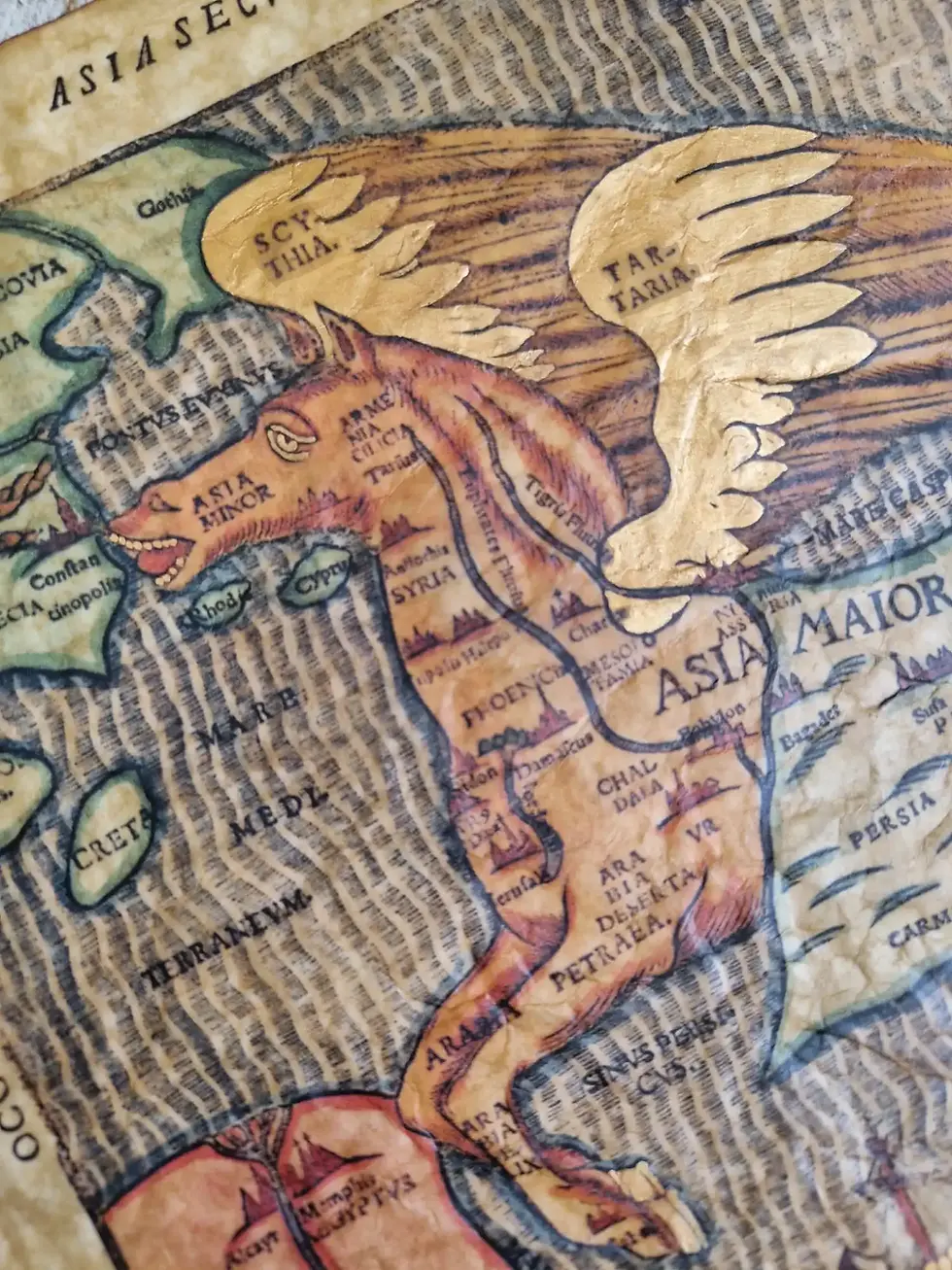
In the world of antique maps, few pieces are as imaginative or as famous as the Asia Secunda in Forma Pegasi. Created in 1581. by Heinrich Bunting, this map does not just show the land. It transforms the entire continent of Asia into the shape of a Pegasus, the mythical winged horse.

In our family workshop, we recreate this stunning piece of map art using traditional methods. We print on thick, hand-processed paper and apply a natural beeswax finish to give it an authentic, old-world glow. Every map features our signature hand-burned edges. This ensures that your replica looks like a genuine discovery from the Renaissance.
Who Was Heinrich Bunting?
Heinrich Bunting was a German pastor and theologian who lived in the late 1500s. He is most famous for his book, Itinerarium Sacrae Scripturae, which was a travel guide for the Bible.
Bunting loved to use symbolic cartography. This means he drew maps in shapes that represented an idea rather than perfect geography. While other masters like Abraham Ortelius were focused on the Roman Empire, Bunting wanted to make the world easy to remember through stories and myths.
The Meaning of the Pegasus Map
When you look at our Asia Secunda in Forma Pegasi replica, you will see how the horse and the land fit together.
Why a Pegasus?
In the 16th century, the Pegasus was a symbol of speed, wisdom, and fame. By shaping Asia as a winged horse, Bunting was showing the vastness and power of the continent. The head of the Pegasus represents Asia Minor (modern-day Turkey). Its wings stretch up toward Scythia and Tartary.
The Regions of the Winged Horse
The Head: Asia Minor and the city of Troy.
The Wings: Northern regions like Scythia.
The Body: The vast lands of Persia and Central Asia.
The Legs: The front legs are Arabia, and the hind legs represent the Indian peninsula and the Malay Peninsula.
Sea Monsters and Ships
Bunting did not stop with the land. He filled the surrounding oceans with terrifying sea monsters and majestic sailing ships.
Key Knowledge for Researchers
Feature | Detail |
Official Name | Asia Secunda in Forma Pegasi |
The Maker | Heinrich Bunting (1545. to 1606.) |
First Published | 1581. in Itinerarium Sacrae Scripturae |
Map Type | Symbolic / Zoomorphic Cartography |
Symbolism | Pegasus as a sign of power and vastness |
Why Our Handcrafted Replicas are Special
We believe that a map this creative should not be a flat, modern print. Our artisan process ensures that each piece feels like a physical piece of history.
Always Hand-Burned Edges: We always burn the edges by hand. This gives each Pegasus map a unique, aged character that sets it apart from factory prints.
Beeswax Finish: Our natural beeswax treatment gives the paper a soft, parchment like feel and a warm glow.
Gold Paint Accents: We hand paint small gold details on the Pegasus's harness and the titles to add a touch of luxury.
Artisan Quality: Each print is made from high-resolution historical sources to keep the 1581. details sharp.
Displaying "The Winged Horse" in Your Home
Because we use thick paper and natural beeswax, these prints are built to last for many years. To truly show off the hand-burned edges, many of our customers choose a "float mount" frame. This makes the map appear to hover inside the frame. It draws attention to its unique shape.

If you want to see how we prepare our paper, you can read more about how we make our parchment replicas. You can also explore other symbolic maps in our complete guide to antique map prints. You can find this handcrafted Pegasus replica and many others in the Antique Map Prints category in our shop here.
Frequently Asked Questions About the Pegasus Map
Is this map geographically accurate?
No. Bunting deliberately distorted the geography to fit the shape of the horse. It was meant to be a symbolic and educational tool. It was not a guide for sailors.
What is the other map Bunting is famous for?
Bunting is also famous for his Clover Leaf Map. It shows the world meeting in Jerusalem, shaped like a three-leaf clover.
Why is the text in Latin?
In 1581, Latin was the language of scholars and scientists. Using Latin allowed people from all over Europe to read and understand Bunting's work.


Comments